
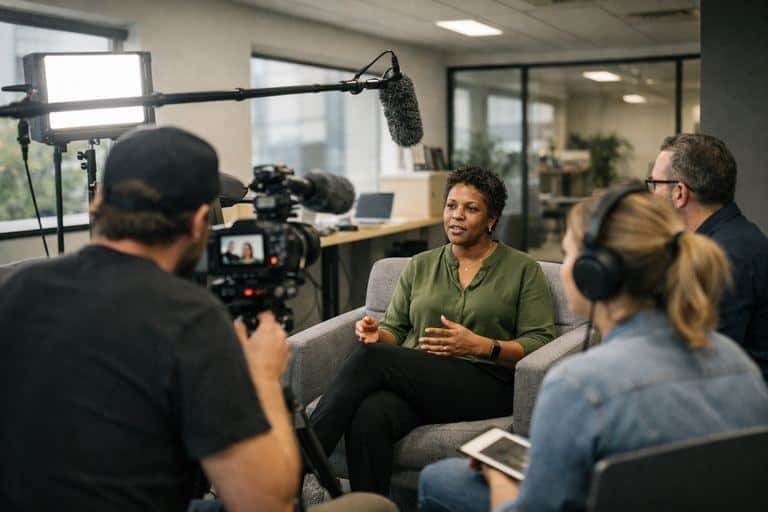
A corporate documentary is a calm, documentary style film that shows how your organisation works in the real world, real people, real environments, filmed in a way that feels credible, not salesy. In practice, a strong corporate documentary video makes complex work feel clear and credible without turning into sales copy.
It’s useful when you need clarity and trust at the same time, recruiting, explaining a service, reassuring stakeholders, or showing what changes for customers. This is where a documentary style corporate video works best, when people need real context before they commit. It gives people something they can watch and understand quickly, without wading through pages of text.
If you’re still deciding what kind of documentary production you need, start here, documentary production.
WHAT IT IS, AND WHAT IT ISN’T
A corporate documentary sits somewhere between a case study and a short documentary film. It’s not a scripted promo full of slogans, and it’s not a feature length, broadcaster pitch kind of project either.
The point is evidence, not claims. We show the work, the process, the delivery, the before and after you can genuinely stand behind, so the viewer feels, I can trust this. When the priority is values in action and team reality, this can also be framed as a corporate culture documentary, with less script and more observed proof.
WHAT IT’S FOR
A corporate documentary works well when the goal is practical, for example, and it can function as a corporate storytelling video for external trust, or as an internal communications documentary when alignment inside the organisation matters.
- Recruitment and employer branding, showing the day to day reality
- Stakeholder comms, helping non specialists grasp what you do and why it matters
- Client confidence, showing competence, systems, and the human side of delivery
- Change projects, making the “why” and the “what” clearer for staff
- Partner or compliance contexts, where proof beats persuasion
- Onboarding and internal training, when nobody reads the documents
WHAT YOU ACTUALLY GET
You get a finished film, edited properly, colour corrected, and mixed so it sounds clean. You’ll also get a web ready version, plus cut downs for social, sized to the platforms you actually use. Captions can be supplied as an .srt file, or burned in if that’s better for your team. For hiring and employer brand work, a recruitment documentary video can show culture, standards, and day-to-day reality far better than polished claims.
It’s also common to include an internal version, especially if parts of the story should stay inside the organisation. We keep reviews structured and calm, so it doesn’t turn into endless “one more tweak” cycles.
HOW WE APPROACH IT
We start with audience and outcome, who needs to watch, what they need to understand, and what you want them to do afterwards. Then we build a simple spine, what needs to be said, what needs to be shown, and what should be left out so it stays watchable.
Filming is planned around real schedules and access, plus any constraints like safety, privacy, and operational windows. On the day we keep the crew sensible and the setup calm, and we take sound seriously, because distracting audio makes even a strong film feel amateur.
TYPICAL LENGTH AND STRUCTURE
Most corporate documentary films land well at 2 to 6 minutes for external use. It’s long enough for context and proof, without asking too much attention from a busy viewer. If the story is anchored around one client outcome, the format can be shaped as a corporate case study documentary, which gives decision makers clear before/after context.
Internal films can be longer, sometimes 6 to 10 minutes, because the audience is already invested. If you need both, we usually recommend two edits rather than forcing one version to do everything.
How approvals work when multiple people are involved
In most organisations, more than one person needs to approve the film. That’s normal. To keep things clear and avoid endless revisions, we ask for one final decision maker and a small feedback group. We then collect comments in one structured round so the feedback is specific, practical, and easy to action.
This keeps the film coherent, speeds up delivery, and avoids the common problem where too many conflicting opinions weaken the final message.
COMMON PITFALLS, AND HOW WE AVOID THEM
- Too many people with equal veto power, we set a review structure early so the film stays coherent
- Turning it into a manifesto, we keep it rooted in what can be shown and evidenced
- Ignoring constraints like access, safety, and timing, we plan around reality
- Trying to make it “cool” rather than clear, we aim for believable and watchable
- Trying to say everything in one film, we help you pick one job, then build versions around it
If what you really need is a trust building homepage film, rather than a stakeholder focused corporate documentary, you may find our brand documentary page is a better fit. If your main goal is customer proof, case study video production may be the better fit. If your main goal is process transparency, behind the scenes video production may be the stronger format.
FAQs
Most projects run about 3 to 6 weeks from first call to final delivery. If you’ve got a deadline we can usually work backwards, but faster timelines need tighter planning and quicker approvals.
Ideally one decision maker for approvals, plus access to the people who actually do the work. If compliance, HR, or comms need to be involved, it’s better to include them early so nothing lands as a surprise at the end.
Yes, and it’s common. The public cut is usually simpler and more polished, the internal cut can go deeper on process, culture, training, or detail that doesn’t belong on a public website.
That’s normal. We agree who signs off, set the non negotiables early, then keep feedback structured so the film doesn’t turn into a committee edit where nothing gets finished.
We prefer real work where possible. Sometimes we’ll repeat an action for camera clarity, but we avoid fake moments, viewers spot them fast.
Next steps
If you’re thinking about a corporate documentary, send a message via the contact page and tell us what the film needs to do, who it’s for, and any deadlines. If you’re comparing options, we can quickly scope whether you need a corporate documentary film, a case-study-led format, or a process-led documentary approach. A rough outline is plenty.
If you’re still weighing up formats, have a look at our documentary production approach, it’ll help you choose the right style without overthinking it.