
If you run a small business, the real question is usually not “how cinematic will this be?”, it is “how long will this take and how much will it disrupt us?” Fair question. Your documentary video production timeline needs to fit real life, customers still need serving, jobs still need doing, and you probably do not have spare people waiting around for content projects.
Most documentary video production projects can move faster than people expect when scope is clear. This guide breaks down a realistic documentary video production timeline, what usually causes delays, and how to keep momentum without cutting corners. If you are searching how long does documentary video production take, this is the practical answer in plain English. You will also see what a lean timeline looks like in practice, so you can plan with confidence instead of guessing.
If you are still deciding format, start with our documentary production overview.
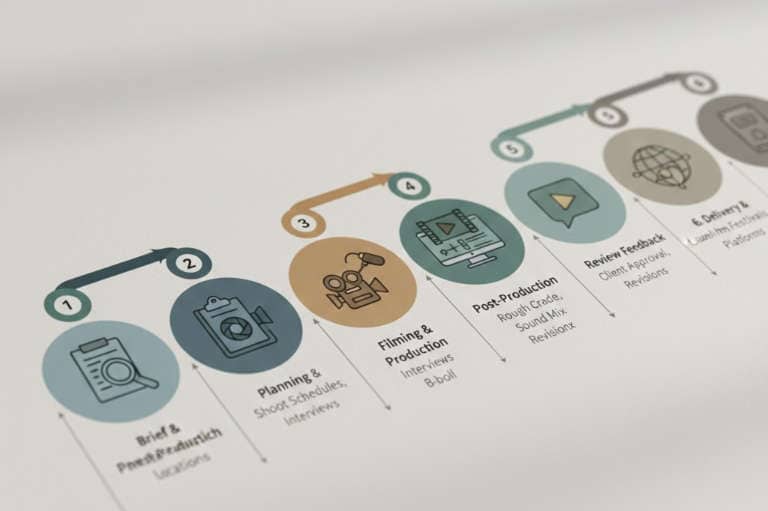
Documentary Video Production Timeline, How Long It Really Takes
For many small business projects, a realistic end-to-end documentary video production timeline is around 2 to 6 weeks. Leaner projects can move quicker. Broader projects take longer. In other words, your documentary video production timescale is mostly shaped by clarity, not camera complexity. If the story, access, and approvals are clear, production moves cleanly. If those are vague, even simple projects drag.
A fast, tight brief can sometimes be delivered in 7 to 14 days, usually one location, one clear message, one decision maker. A more typical single-film project lands around 3 to 4 weeks, which gives enough room for planning, filming, and a sensible edit process. A realistic documentary video turnaround time for that kind of project is usually within that 3 to 4 week window. If you add more filming days, multiple versions, or slower approvals, 5 to 8 weeks is normal. So if you are asking how long does video production take, the honest answer is, it depends on scope and decisions. None of that is bad, it just means you should plan honestly from day one.
The important thing is not chasing the shortest timeline. It is setting a timeline that protects quality while fitting your real-world workload.
[IMAGE PLACEHOLDER, simple timeline bands: 1-2 weeks, 3-4 weeks, 5-8 weeks]
Where The Time Actually Goes
Most of the timeline sits in four phases, brief, plan, film, and edit. If each phase is clear, projects move smoothly. If one phase is fuzzy, everything slows down. A lot of people assume filming is the long part. Usually it is not. The biggest time sink is indecision before and after filming, unclear priorities before the shoot, then scattered feedback during editing.
- Brief and planning: usually 2 to 7 days, depending on access, goals, and availability.
- Filming: often half a day to 2 days for small business projects.
- First edit: typically 5 to 10 working days after filming.
- Revisions and sign-off: usually 2 to 10 days, based on response speed.
That is why quick feedback matters. Slow review loops are one of the biggest causes of delay, even when the production itself is moving well.
Small Business Timelines, Keep It Lean, Keep It Useful
Most small businesses do not have spare teams waiting around for content projects. You are usually juggling delivery, sales, and operations while trying to get better marketing assets in place. That is why timeline matters so much, not because you are impatient, because lost time has a real cost. A good production process should feel supportive, not like another operational headache.
That is why we keep the process compact. One clear objective, one focused shoot, one strong edit, then useful cutdowns. This approach usually gives the best balance between speed, quality, and disruption. It also helps you get value sooner, your film can start working on your site while you are still deciding whether you want extra versions later. That phased approach is usually the smartest way to keep momentum without overcommitting time.
If your goal is process-led trust, behind the scenes video production is often the fastest route to a useful result, and a behind the scenes video production timeline is usually short when access is straightforward. If your goal is one proof story around an outcome, documentary case study video can also be delivered quickly when scope is tight, with a case study video production timeline often landing in the 2 to 4 week range.
What Usually Slows A Project Down
Most delays are avoidable. They usually come from unclear priorities, access changes, or late-stage edits that change direction. In plain terms, the film starts as one job and quietly turns into five jobs. That is where schedules blow out.
Typical blockers include trying to cover too much in one film, uncertain sign-off ownership, and slow feedback between edit rounds. Another common one is practical, filming gets booked before key people are actually available. None of this is dramatic, but it adds up quickly.
A simple rule that works, agree the goal, agree the decision maker, and lock filming access before shooting day. Timeline risk drops immediately.
What A Real Documentary Timeline Looks Like, Week By Week
Week 1: You lock the goal, audience, and filming access. This is where speed is won or lost. If this week is clear, everything else gets easier.
Week 2: Filming happens. For many small businesses, this is one focused shoot day. Good planning means the day feels calm, not chaotic, and people can still get their normal work done.
Week 3: First edit arrives. You review against the agreed goal, not personal taste swings. Feedback comes back in one clean round. Revisions are applied, and delivery follows quickly.
If scope is broader, add extra time, but keep the same logic, clear decisions, focused filming, structured feedback. Whether your project is quick or more involved, that rhythm protects both quality and timeline.
[IMAGE PLACEHOLDER, week-by-week timeline strip with milestones]
How To Keep Documentary Video Production Timelines Fast
- Start with one clear job for the film, not six competing goals.
- Set one decision maker for approvals.
- Confirm access windows and contributor times before filming day.
- Respond to edit feedback in one consolidated round.
- Ask for only the outputs you will actually use now.
If your story really needs multiple chapters, mini documentary series can be planned in phases so delivery starts sooner while later episodes are still in production. For larger organisations, a corporate documentary production timeline is often longer because approvals and access are broader. For nonprofits, a charity documentary video timeline may include extra consent and safeguarding steps, which is normal and worth planning for up front.
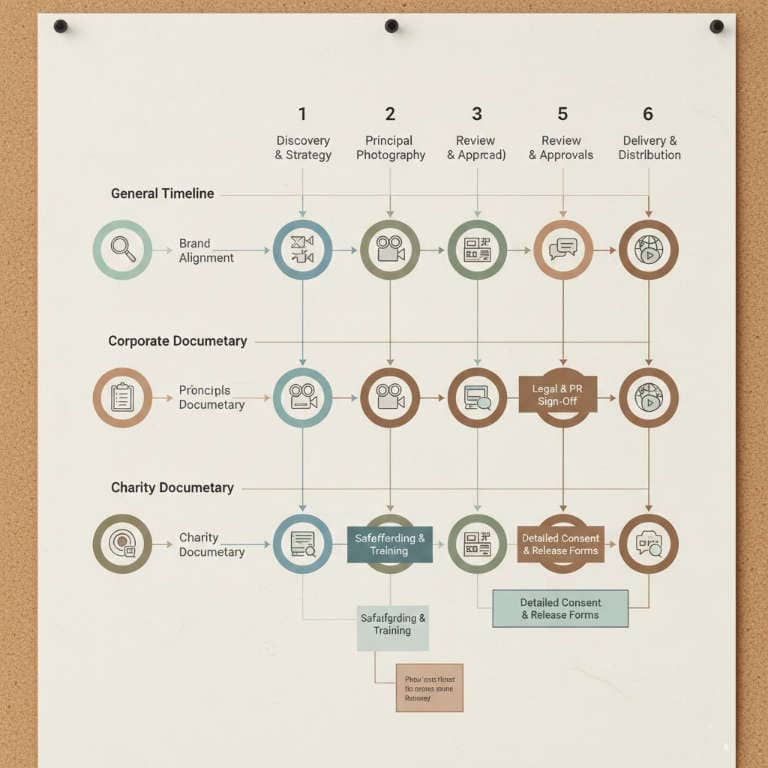
FAQs for documentary video production timelines
Often in 2 to 4 weeks when the brief is focused and approvals are quick. Tight projects can be faster, broader projects can take longer. The fastest projects usually have one clear objective, one person signing off, and filming access confirmed before the date is locked.
Editing and feedback loops usually take longest. Filming might be one day, but reviews can stretch if feedback comes in slowly or from too many directions. The practical fix is simple, gather feedback once, prioritise what affects the goal, and avoid reopening settled decisions every round.
Yes. Keep scope focused, set one decision maker, and send feedback in one consolidated round. That usually cuts delays without reducing quality. Speed and quality can work together when the project has clear boundaries and the team sticks to them.