
Charity video production is one of those phrases that sounds a bit functional, but what people usually mean is simple. You need a film that helps someone understand what you do, why it matters, and what changes because you exist. Not in a glossy advert way, and not in a “look how inspiring we are” way either. More like an honest window into the work, with real people, real places, and a clear purpose.
For most teams, charity video production is really about trust. Donors and funders need to believe you, partners need to understand you, and the people you serve need to feel respected, not turned into “content”. A strong charity storytelling video helps people understand your work without turning people’s lives into a campaign prop.
If you’re still deciding what kind of documentary production you actually need, start here, documentary production.

What It Is, And What It Isn’t
A charity film production can be documentary in style, interviews, observational moments, real environments, but it is usually commissioned with an outcome in mind. That outcome might be fundraising, awareness, volunteer recruitment, stakeholder reporting, or explaining a service to people who are new to it. For organisations reporting outcomes to funders, a charity impact film can show what changed in clear, human terms.
What it isn’t, is a tearjerker built to squeeze emotion out of someone’s worst day. It also isn’t a “Netflix style” feature length project with months of access and a broadcaster’s budget. We can make longer films when it makes sense, but most charity campaign video production works best when it stays focused and watchable.
Who It’s For
Charity video production is a good fit when you have something meaningful happening, but you’re struggling to show it without writing a small novel on your website. It’s for teams who want to build trust quickly, with donors, funders, partners, referrers, trustees, and the communities you serve. This approach also overlaps with nonprofit video production when teams need clarity, trust, and practical delivery assets across channels.
It’s also for charities who want to protect dignity and consent while still telling the truth. That sounds like a given, but it’s surprisingly easy for a film to drift into “story first, people second” if nobody sets boundaries early.
If your charity also needs stronger website conversion, this guide to videos small businesses can use is a useful companion.
What It’s For
Here are a few grounded use cases, the sort of things people actually commission charity video production for. For awareness campaigns, a charity awareness video can explain the issue and your role in addressing it, without overdrama. If the brief is mainly one intervention outcome, case study video production may be the better fit. If the story has multiple chapters to release over time, mini documentary series may be a better format.
- Fundraising page film, a clear, human story that sits above the donate button and actually gets watched
- Grant and funder support film, showing delivery in the real world, not just outcomes in a PDF
- Service explainer film, helping families, clients, or referrers understand what to expect
- Volunteer recruitment film, showing what volunteering is really like, and who will feel at home
- Campaign film, awareness raising, policy, community issues, and public education
- Stakeholder update film, a calm “here’s what happened this year” piece for trustees, partners, or internal audiences
What You Actually Get
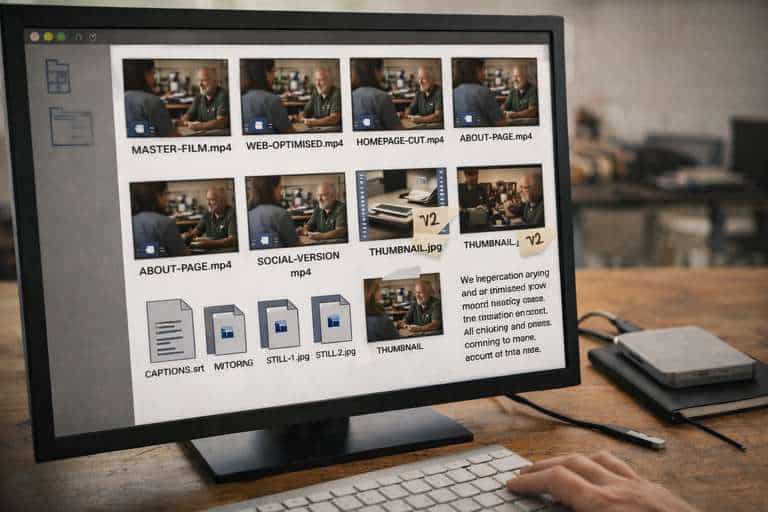
- A finished film, edited properly, colour corrected, and mixed so it sounds clean
- A version that works on your website, usually landscape
- Cut downs for social, sized for the platforms you actually use
- Captions file, and burned in subtitles if you want them
- A thumbnail still, plus a few additional stills for web use if it helps
- Delivery in sensible formats, and we’ll keep the project organised so you’re not chasing files later
For charity video production we can also create versions that suit fundraising pages, partner presentations, and quieter internal screenings, where the tone needs to be steady rather than “marketing”.
How We Approach It
The planning is where we protect people. Before we pick up a camera we get clear on who the film is for, what it needs to help them do, and what would feel like a line too far. Charity fundraising video production often involves vulnerable stories, safeguarding needs, and situations where people may say yes in the moment but feel exposed later, so we build in a consent led approach. When the objective is donation action, a donor appeal video should stay specific, credible, and easy to act on.
That usually means we agree, in plain language, what participation involves, how the footage will be used, and what the review process looks like. If a contributor is in a sensitive position, we’ll talk about options, filming hands, voices, environment, or anonymous storytelling, instead of pushing for a full face interview because it “performs better”.
On the day, we keep the crew sensible. Documentary style filming can be calm and unobtrusive, which matters in care settings, community spaces, and busy service environments. We’re looking for real moments, not staged ones, and we’ll work around your reality rather than trying to make your work fit our shot list.
After filming, we edit with restraint. Charity video production can be moving without being manipulative. The difference is pacing, music choices, and what you leave out. Sometimes the strongest thing you can do is let someone speak plainly, with space around it.
Impact Without Emotional Manipulation
A lot of charities worry they have to “tell the whole story of the organisation” in one film. That’s a trap. The best charity video production usually picks one clear thread and follows it, one person’s journey, one service location, one day in delivery, one volunteer role, one specific problem your work reduces. If your goal is proof around one intervention or partner outcome, this can be shaped as a charity case study video.
If the charity has multiple programmes, we can shape a small series, or a main film plus a couple of cut downs, but we still keep each piece honest and bounded. People can sense when a film is trying to cover everything, it starts to feel like a brochure.
Typical Length And Structure
Most charity video production for websites sits around 2 to 4 minutes. That tends to be long enough to feel human, but short enough that people finish it. Fundraising and campaign films are often tighter, around 60 to 120 seconds, because they’re usually watched on social or on busy pages.
A common structure looks like this. Start with the reality, a short moment that shows the problem or the setting. Then introduce the charity’s role, what you do, in human language. Show the work in action, not just talking heads, this is where trust is built. Finish with what changes, and what you want the viewer to do next, donate, share, volunteer, partner, refer.
If you need a public cut and an internal cut, for example for trustees or funders, we can do that too. Sometimes the internal version can be more detailed, a little slower, more outcomes, less “hook”. If that’s the kind of project you’re considering, have a look at our corporate documentary page as well, because the stakeholder reality overlaps.
Common Pitfalls
- Over dramatising. It can backfire, people feel emotionally pushed, and they switch off. We keep it truthful and specific.
- Stories without context. A personal story matters more when the viewer understands what support made the difference.
- Stats without people. Outcomes land better when you see where they came from, even briefly.
- Trying to film everything in one day without access planning. We’d rather plan properly and get what matters than hope we catch it.
- Losing sight of consent. Charity video production needs a process that protects contributors, not just the organisation.
Examples
Example 1: Charity video production for [Charity Name], goal, fundraising page film, 2:30, used on [page or campaign]
Example 2: Charity documentary film for [Charity Name], goal, volunteer recruitment, 1:45, used on social and website
Example 3: Video production for charities, [Charity Name], goal, stakeholder update, 3:30, used for trustees and partners
FAQs
We plan this properly, rather than treating it as a formality. We’ll agree who can be filmed, what’s appropriate to include, how consent is captured, and who signs off internally. If anyone is vulnerable, or the situation is sensitive, we work with your safeguarding lead so the filming approach stays respectful and safe.
We also keep the shoot calm and low pressure. People share more naturally when they don’t feel “performed”, and that usually leads to a better film anyway.
Yes, and it’s usually the better route. We focus on real detail, clear context, and simple before and after, rather than dramatic music and “pull the heartstrings” editing. If something is moving, it will land without being pushed.
We’ll also shape the story around who needs convincing, donors, trustees, community partners, volunteers, because each audience hears things slightly differently.
Usually 2 to 4 minutes is a solid range for a main fundraising page film. It’s enough time to understand the problem, meet a real person, and see what changes. If you need a longer story, we’ll normally suggest a shorter cut too, so there’s an easy entry point.
For social, it tends to be tighter, often 30 to 90 seconds, with the full film living on the donation page or your YouTube channel.
Most charity films work best when they’re interview led, supported by real world footage. You don’t usually want a word for word script, because it can make people sound less like themselves. What helps is a clear structure and good prompts, so the story stays focused and kind.
If you do need a scripted voiceover, for example for clarity, anonymity, or translation reasons, we can build it that way. We just decide early so the filming and edit are shaped around it.
Yes, and we’ll build them as proper versions, not random clips. The main film does the depth and context, the shorter cut downs do the attention grabbing and sharing. We can also provide the right aspect ratios for the platforms you actually use.
Talk To Us About Your Charity Film
If you’re considering charity video production, the simplest next step is to send a message through the contact page. Tell us what the film needs to achieve, who it’s for, and any deadlines you already know. If you’re unsure on format, say that, we’ll help you shape it.
You can also step back and look at our documentary production page for the wider picture of how we work, and which documentary formats tend to fit which outcomes.