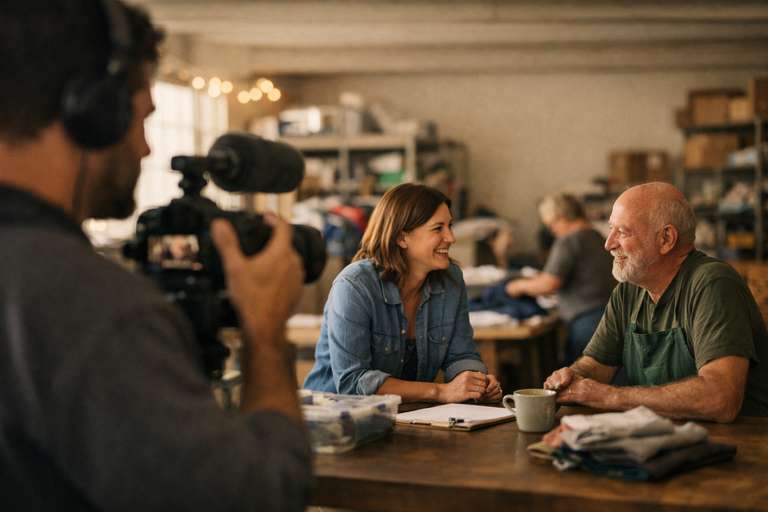
A brand documentary is a short film that helps people understand who you are, without you having to shout about it. It’s documentary style, real people, real places, and a tone that feels observed, not performed. In practical terms, it works as a documentary style brand video that builds trust before someone is ready to act.
It suits organisations, charities, and small businesses who do good work but feel their website doesn’t show it yet. You might have happy clients and strong standards, but the trust gap is still there, people don’t know you, so they hesitate.
The outcome is usually simple, trust that leads to action. Someone watches, feels comfortable, and takes the next step, enquire, donate, apply, book, partner, whatever your page is asking.
If you’re still deciding what kind of film you need, start here, documentary production.
What It Is, And What It Isn’t
A brand documentary film isn’t a glossy advert in disguise. If it’s just nice shots plus slogans, people clock it fast and it stops feeling believable. A good brand documentary video feels like real evidence, not polished claims. Documentary style works because it feels like real life, calm, specific, and human.
It’s also not a broadcaster pitch or a feature length commission. This is about short films that live on websites, landing pages, fundraising pages, and social channels, films that do a job.
It doesn’t need to be dramatic. Quiet competence reads as confidence, and it usually ages better too.
If what you really need is a simpler, more direct promo, have a look at video for small business.
What A Brand Documentary Is For
Most people commission a brand documentary because they want one of these outcomes, without turning their whole month into a marketing project. In effect, it works as a brand narrative video or brand storytelling video that helps people understand your values and standards quickly. If your priority is hard proof from a specific client outcome, case study video production may be the better first format.
- Building trust on a homepage, especially when people arrive cold from Google or a recommendation
- Making an about page feel real, so it doesn’t read like a biography nobody believes
- Explaining what you do when it’s hard to describe, because the value is in the nuance
- Supporting enquiries for high trust services, where people need reassurance before they reach out
- Helping with recruitment, showing culture and standards rather than promising them
- Creating a film for proposals and presentations, when words alone feel thin
It’s basically the fastest way to shorten the gap between “I’ve never heard of you” and “I think I trust you”, without explaining everything in ten paragraphs.
Finding The Real Story Angle
This is where brand documentaries either work beautifully, or drift into “nice film, so what”. A strong brand story documentary starts with one truthful thread that viewers can follow and believe. The good version starts with a thread people can believe. Not a clever tagline, more like a true sentence.
The Difference Between A Story And A Message
A message is what you want to say. A story is what the viewer experiences. Documentary style works when the story does the heavy lifting, through real moments, real detail, and the way someone speaks when they’re not reciting a line.
How We Find The Thread
We find it by asking practical questions, what do people misunderstand about you, what do customers thank you for, what are you fussy about, what won’t you compromise on, what do you quietly do better than the “big” options. Those answers are usually stronger than the marketing version because they’re specific.
Once we’ve got the thread, decisions get easier. Who should speak, what should we film, what proof does the viewer need, what should they feel by the end. It stops being vague and starts being filmable.
The Business Owner Story Without Cringe
A lot of brand documentaries include the business owner story. It can be brilliant, or it can feel awkward, depending on how it’s handled. If the owner journey is the centre of the piece, this often sits closer to a brand story film, and this page may help, company story video.
The cringe usually comes from over scripting, forced emotion, or trying to sound bigger than reality. So we keep it grounded in real decisions and real moments, what you noticed, what you changed, and what you care about in practice.
Prompts, Not Scripts
We guide with prompts rather than a word for word script. People sound more like themselves, and the film feels more truthful. If someone goes blank, we pause, reset, and pick it up again. It’s not a performance, it’s a conversation.
Balancing The Voice
If it helps the film feel less one sided, we can bring in other voices too, a team member, a customer, a partner, someone who can describe what it’s like to work with you. Not in a testimonial way, more in a “this is what happens here” way. That balance often makes the film feel more credible.
What You Actually Get
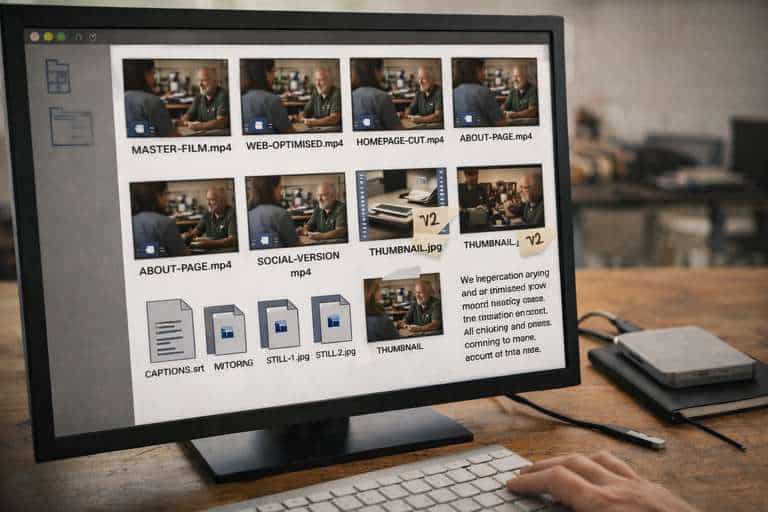
You get a finished film, edited properly, colour corrected, and mixed so it sounds clean. You also get short documentary film production cut-downs for social and campaign use where needed. You also get versions that make it easy to use across your site and channels, without you having to figure out the technical bits.
- A final master film, exported for your website and YouTube
- A web optimised version that loads quickly and still looks sharp
- A homepage friendly cut, usually tighter, built to hold attention quickly
- Cut downs for social, sized for the platforms you actually use
- Captions file, and burned in subtitles if you want them
- A thumbnail still, plus a few additional stills pulled from the footage
We keep delivery tidy, with sensible filenames and versions that match where you’ll actually use them. It sounds minor, but it saves a surprising amount of time later.
How We Approach A Brand Documentary
We keep it calm and practical. First we agree the story thread and the purpose, what the film needs to do, and where it’s going to live. Then we plan what we need to capture so it feels like documentary, not someone talking on a chair. The aim is to produce a documentary brand film that feels true to how your organisation actually works.
Interviews are usually the backbone, and b-roll is the proof. We plan b-roll around what actually shows competence, care, systems, detail, and real work, not just pretty shots.
Filming stays low fuss. Small crew where possible, the right kit for the job, and a setup that helps people relax quickly. This style depends on people sounding like themselves.
Then we edit and send a first cut. You send notes, we do the agreed revision rounds, and we finish the final versions properly, so you’re not left with one random file that works nowhere.
Typical Length And Structure
For most websites, 2 to 5 minutes is a strong range. It’s long enough to feel real, short enough that people finish it.
A common structure is simple, a quick opening for context, a human voice early, proof through b-roll, then the thread of the story, finishing with a sense of “now you know us”. It doesn’t need a hard sell.
For social, cut downs are often 30 to 90 seconds. They need different pacing, not random clips, more like a mini story that points people towards the full film on your site.
Common Pitfalls, And How We Avoid Them
Trying to sound bigger than you are, viewers sense it and trust drops. We keep it confident but honest.
Over scripting the humans, it makes people stiff. We use prompts and structure, but keep it natural.
Trying to say everything in one film, when you cram it all in, nothing lands. We pick a clear thread and commit to it.
Making it look like an advert in disguise, music, wording, and pacing matter. We keep it grounded so it reads as real.
Ignoring where the film will live, a homepage film is paced differently to a presentation film. We plan versions early so you’re not forcing one edit to do every job later.
Examples (With Labels)
If you’ve got examples ready, we can embed them here. If not, leave placeholders for now. The label does a lot of work.
Example 1: Brand documentary for [Organisation Name], goal: [Trust building for enquiries], used on: [Homepage, About page], deliverables: [Main film, homepage cut, captions].
Example 2: Documentary style brand film for [Organisation Name], goal: [Recruitment], used on: [Jobs page, LinkedIn], deliverables: [Main film, cut downs, subtitles].
Example 3: Brand documentary film for [Organisation Name], goal: [Fundraising or partnership support], used on: [Landing page, presentations], deliverables: [Main film, short cut, stills].
FAQs for a brand documentary
For most websites, 2 to 5 minutes is a strong range. It’s long enough to feel real, but short enough that people finish it. For social, cut downs are often 30 to 90 seconds.
Usually no. Documentary style works best when people speak naturally. We use prompts and structure so it stays focused, but it still sounds like you.
Most people feel a bit odd at first. We keep the setup calm, use prompts, and let people settle. It usually stops feeling like being filmed and starts feeling like a conversation.
Talk To Us
If you’re considering a brand documentary, send us a message and tell us what you want it to achieve, where it’ll live, and any deadlines you already know about. If you’re comparing options, we’re happy to show how a documentary production company should scope this so it stays clear and useful. Even a scrappy message is fine, contact page.
If you want the broader overview of how we approach documentary projects, start here, documentary production company approach.
Contents
- 1 What It Is, And What It Isn’t
- 2 What A Brand Documentary Is For
- 3 Finding The Real Story Angle
- 4 The Business Owner Story Without Cringe
- 5 What You Actually Get
- 6 How We Approach A Brand Documentary
- 7 Typical Length And Structure
- 8 Common Pitfalls, And How We Avoid Them
- 9 Examples (With Labels)
- 10 FAQs for a brand documentary
- 11 Talk To Us